
Certified Indoor Environmental Investigation Technician (CIEIT)
This course offers an in-depth exploration of indoor environmental investigations, with a focus on evaluating building structures, detecting moisture and contaminants, and implementing mitigation strategies. Students who complete the course will receive certification as a Certified Indoor Environmental Investigation Technician (CIEIT), which attests to their proficiency in environmental diagnostics, sampling methodologies, and their understanding of relevant regulations and guidelines. To enhance their learning experience, students will also receive practical training through real-world investigation scenarios.

Overview
Certification
As a CIEIT-certified technician, you’ll provide professional indoor environmental investigations that help ensure safe, healthy, and hazard-free buildings.
This Assessment-Based Certificate (ABC) program verifies your expertise in structural assessment, contaminant identification, and diagnostic sampling while reinforcing your commitment to maintaining recognized industry and health standards. After passing the exam, you can proudly display your digital IAQCert badge on your website, flyers, or social media to highlight your verified professionalism and dedication to environmental excellence.
Learning Approach
1. LearnEase
Ideal for beginners, offering 41 engaging course items (lessons, quizzes, and assignments) across comprehensive modules. Engage at your own pace and use the extensive material as a valuable resource bank.
Start Learning Now!
2. CertFast
Perfect for experienced professionals. A focused exam to validate your skills quickly, bypassing the extended learning modules.
Get Certified Fast!
Learning Outcomes
- Conduct comprehensive indoor environmental and building investigations.
- Identify sources of moisture intrusion, mold, and airborne contaminants.
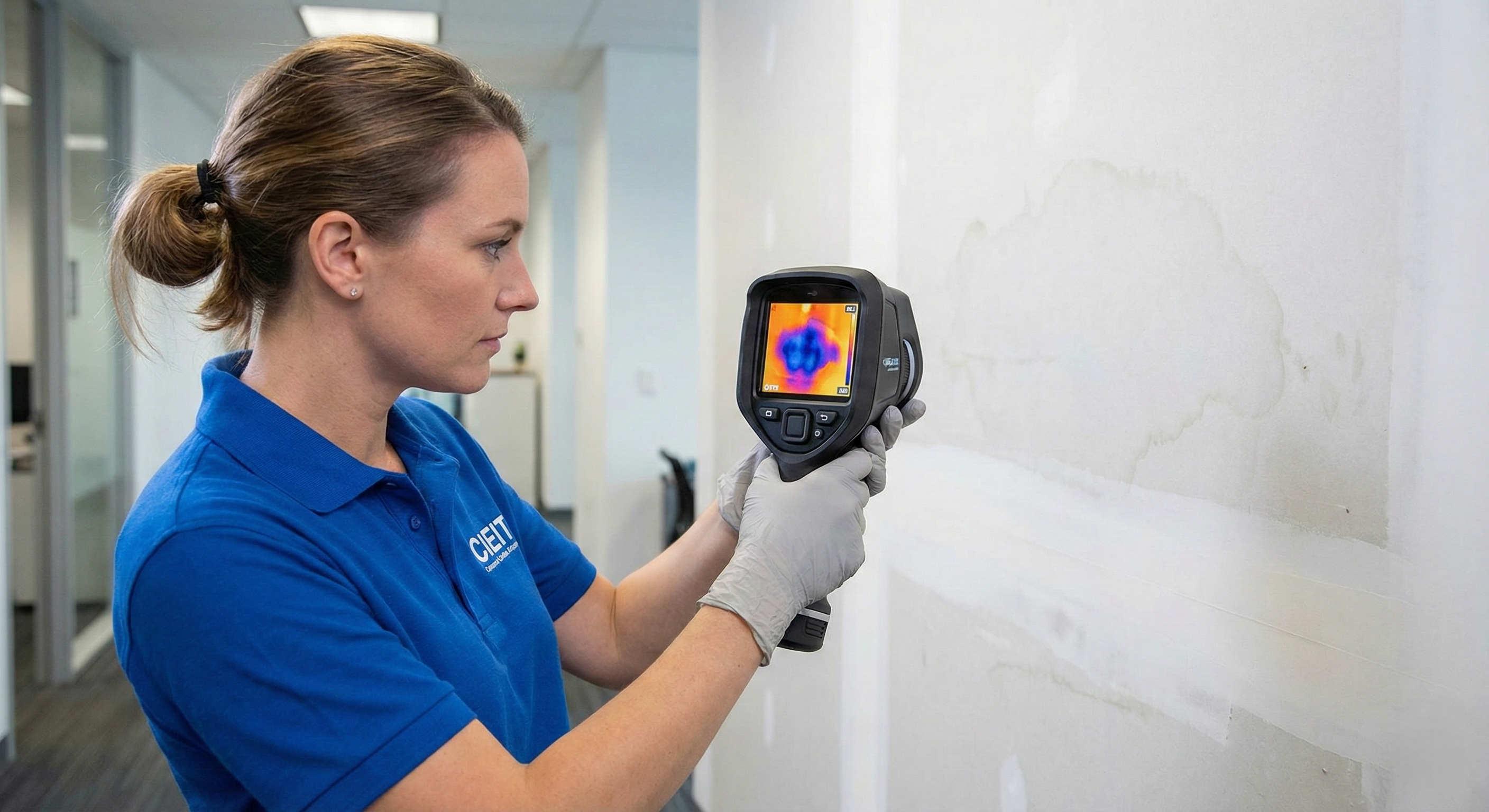
- Evaluate building envelopes and HVAC systems for environmental impacts.
- Select and utilize appropriate diagnostic tools and sampling methodologies.
- Interpret environmental data and formulate effective remediation protocols.
- Communicate findings clearly to stakeholders and clients.
- Maintain accurate documentation and chain of custody.
- Comply with current environmental health regulations and industry guidelines.
Offering both a Comprehensive Learning Path (LearnEase) and a Fast-Track Exam Path (CertFast), our CIEIT course equips you with essential skills and knowledge as an Indoor Environmental Investigation Technician.
Enrollment & Certification Policy
Your enrollment includes full access to all course materials and the final exam for one year from your original date of enrollment. Certification is awarded immediately upon successfully passing the exam, and it remains valid until one year from your initial enrollment date. Students who enroll in a Technician Certification are eligible to receive one Safety course of their choice free of charge. To redeem this benefit, please contact IAQCert support after completing your Technician course enrollment.
Curriculum
Curriculum
- 13 Sections
- 41 Lessons
- 52 Weeks of Access
- Chapter 1 – The Investigative MindsetYour first step is a shift in mindset: you're not just collecting samples, you're building a case. This chapter sets the CIEIT foundation—evidence over assumption, hypothesis over guesswork.4
- Chapter 2 – Human Factors & CommunicationPeople are your best sensors. Learn how to run intake that captures the real story, cluster symptoms, and speak to clients in a way that builds trust and clarity.4
- Chapter 3 – The Building as a SystemBuildings breathe, leak, and respond to weather and use. This chapter ties construction type, envelope, and history to airflow and IAQ so you see the building as one system.4
- Chapter 4 – Pressure & PhysicsPressure is invisible but drives where air and contaminants go. Master the physics, then measure it—stack effect, zone pressure, and pressure-driven transport.4
- Chapter 5 – Advanced HVAC InteractionHVAC can fix or worsen IAQ. Learn static pressure (TESP), oversizing, short-cycling, and ventilation effectiveness so you diagnose system-driven problems with confidence.4
- Chapter 6 – Moisture & Vapor ForensicsMoisture drives mold, odor, and decay. Follow moisture in all its forms—liquid, vapor, and capillary—and connect vapor drive and thermal bridging to real-world damage.4
- Chapter 7 – Specialized Investigations: ChemicalChemical complaints need a clear approach: intake, measurement tools (including PIDs where appropriate), and source tracing—plus how to explain findings to clients.3
- Chapter 8 – Specialized Investigations: ParticulateParticulate type and size drive health and comfort. Learn what to sample, how to interpret data, and how it fits into the larger investigation and report.3
- Chapter 9 – Specialized Investigations: PathogensPathogen investigations tie biology to building conditions. Focus on moisture linkage, sampling protocols, chain of custody, and guiding clients toward remediation.3
- Chapter 10 – Specialized Investigations: Wildfire SmokeWildfire events demand clear assessment and messaging. Learn infiltration pathways, filtration and pressurization, and how to talk to building owners during and after events.2
- Chapter 11 – The Root-Cause ReportYour work lives in the report. This chapter is about evidence chain, documentation standards, and writing reports that are clear, defensible, and useful to clients and other professionals.3
- Chapter 12 – Expert Ethics & BusinessClose the loop: ethics, authority positioning, and the business of being a CIEIT specialist. Communicate like an expert, set boundaries, and position yourself for high-fee, high-trust work.3
- CIEIT Exam5
Course Features
- Lectures: 41
- Quizzes: 5
- Modules: 12
- Skill level: All levels
- Exam: 1-Hour
- Students 0
- Certificate: Yes
- Assessments: Self